




Issue 5: The Grandeur of Lawrence College
Theme: Foundational Truths in CX, EX, and Human Experience Design
Within our journey lie valuable insights into the ways our life experiences shape who we are and how we serve others. At its core, human experiences remind us that our past is not separate from our professional lives; instead, it informs us of the way we listen, empathize, and design meaningful experiences.
By reflecting on lived moments, we uncover timeless truths that guide us toward better human connections, stronger organizations, and more impactful service.
Together, we will explore how personal history becomes professional wisdom —and how those reflections can empower us to elevate CX in every interaction.

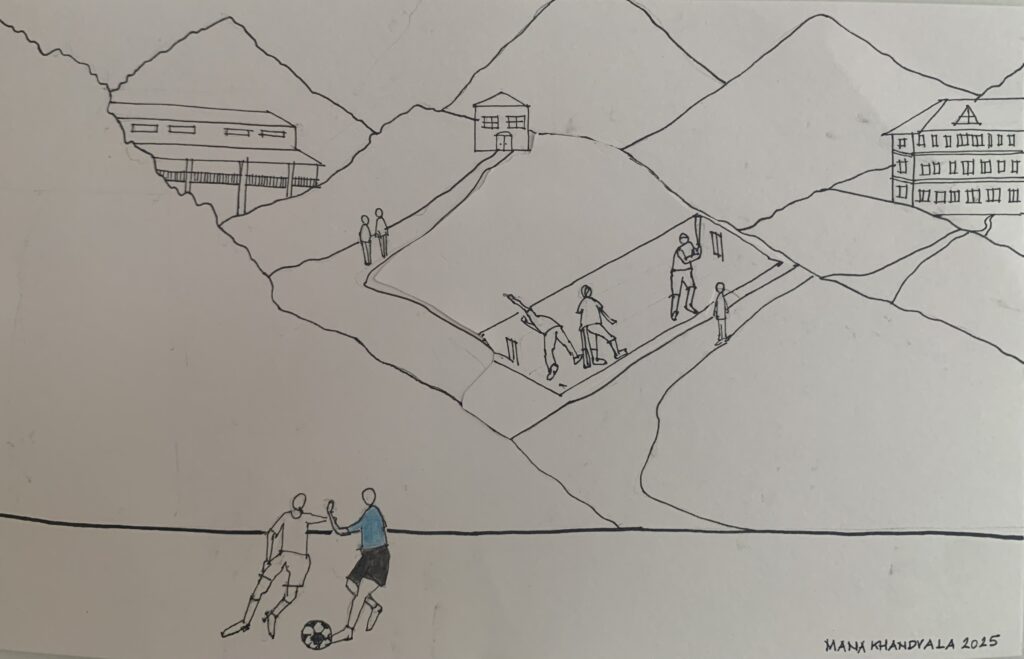
This chapter chronicles my formative years at Lawrence College in the Himalayas, where prestige, discipline, and natural grandeur coexisted with austerity, hierarchy, and normalized indignity. While the institution rewarded academic and athletic excellence, it also embedded a culture of power that legitimized humiliation and corporal punishment.
The campus itself was a blend of grandeur and austerity. Its impressive stone buildings stood proudly against the mountain backdrop. Yet, there were no luxuries, no hot running water, no central heating, and there were cold concrete floors. Baths required heating water with an electric rod, and at night, steel-frame beds with woven metal bases supported thin mattresses.
We would cocoon ourselves tightly under thick quilts, careful not to shift and lose the small pocket of warmth we had created. Hot water bottles were prized.
In addition to emphasis on academics and sports, school culture was disciplined, and corporal punishment in the form of painful pushups or long jogs was common. Prefects or the head boy, who held strict authority, administered this punishment. I was quietly reminded of the oppression of apartheid, a system in which authority rested with the privileged who were authorized to punish at will. The culture of the school encouraged the practice.
I abhorred this tradition! I rose to become the head boy.
But I never forgot where I came from. To punish another student felt unconscionable; to strip someone of their dignity was a violation I could not commit. I began to recognize that I was turning a corner in my own journey away from oppression. In the school’s century-long history, I was the only head boy who refused to wield authority as a weapon. My role was not to command, but to lead. I never punished anyone—and I carried that quiet defiance with pride.
This choice marked a personal liberation: not from race-based oppression alone, but from indignity itself, regardless of who wields it.
At the end of the school year, I boarded a bus with friends, all eager to reunite with their families. The agreed drop-off was a bus depot in Rawalpindi, thirty miles away. When we arrived, my friends were quickly engulfed by waiting relatives and entourages of helpers. Helpers whisked the bedding and suitcases into waiting vehicles. I watched my luggage on the tarmac.
One by one, I embraced my friends and wished them well. Before long, the depot stood empty—everyone had gone. I was alone, with no family waiting, no place to go. With nowhere else to turn, I hoisted my belongings and trudged to a cheap hotel for the night, telling myself I would head for Lahore—240 miles away—the next day.
CX Lessons Extracted from the Narrative
| Narrative Moment | CX Insight | Application to CX & Leadership |
| Prestigious school with harsh living conditions | Excellence can coexist with discomfort; memory is shaped by emotional contrast | CX leaders must address emotional pain points even in “high-performing” systems |
| Corporal punishment normalized by culture | Authority without empathy erodes trust and safety | Design governance and policies that remove fear-based compliance |
| Rise to head boy with power to punish | Leadership is a choice, not a title | Empower leaders to model dignity, not dominance |
| Refusal to punish others | Psychological safety creates moral authority | CX cultures must reward restraint, fairness, and humanity |
| Athletic recognition granting privilege | Systems often reward talent while excusing harm | CX metrics must balance performance with values and ethics |
Leadership Takeaway
1. Lead with Moral Clarity.
2. Design Against Indignity.
3. Measure What People Feel, Not Just What They Do.
4. Protect the Vulnerable at Their Most Exposed Moments.
5. Liberation Is an Experience Outcome.
Closing Thought
Regardless of industry, the highest aspiration of experience design is not satisfaction—it is freedom from fear, disrespect, and invisibility.
Performance metrics without dignity metrics create toxic success.
* Some content/design elements in this HXI were assisted by AI tools, with final editing by the CXU team.
Biography of Mohamed Latib
Mohamed Latib, Ph.D., established CX University, leveraging his extensive background as a customer experience (CX) specialist and his academic tenure, including roles as a professor, Dean, and Vice President at various distinguished institutions, spanning over 35 years. Latib has been a pioneer in adult
continuing education globally, including in the United States, Europe, Asia, and Latin America. With a career in CX spanning over three decades, Latib co-founded a previous company where he deployed customer feedback systems for notable brands such as Kohl’s, Fossil, TransUnion, The World Bank, Project Management Institute, Citibank, and more.
Under his leadership, CX University has influenced the CX discipline globally and was recognized by CXPA in 2022 with the Impact Award. CXU is also recognized as among the best CX certification programs in the USA. Latib has spearheaded several cultural transformation efforts and contributed to developing senior executives at companies like Air Products, Pennsylvania Power & Light, Siemens, Smithfield Meats, Dominion Textiles, Unisys, and others.
An accomplished author, he has written numerous articles and papers. He earned an MS in Psychology, an MBA, and a Ph.D. in Business Administration focusing on Organizational Behavior, Human Resources, and Strategy from the Fox School of Business and Management at Temple University.